People read our file as «the first STO in Liechtenstein». Fair — but that is one chapter. The harder lesson is consecutive capital increases: the same AG coming back to the register again and again with new economics — cash, Sacheinlage, subscription proceeds — while the question mutates each time: Is this a Kapitaleinzahlungskonto? Is this evidence enough? Who signs the letter?
We learned on our own cap table first, then on issuer mandates. For the greater good of society — and at a cost in time we would not repeat blindly — here is what counted.
Increase #1 — our own AG: Sacheinlage in USDC, Bitcoin, Ethereum
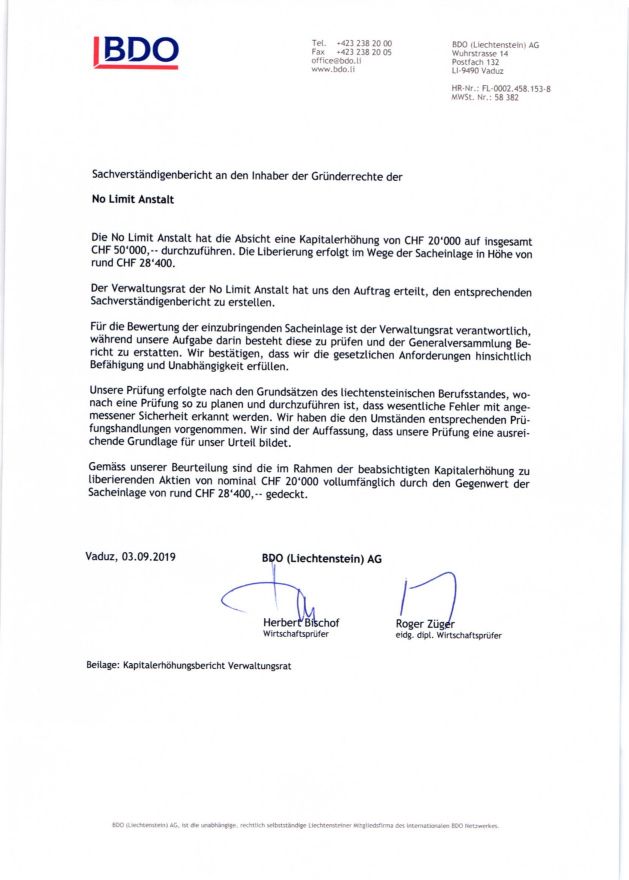
2019: No Limit Anstalt → Equanimity AG, capital raised from CHF 30'000 to CHF 50'000 via contribution in kind — a mix of USDC, Bitcoin, and Ethereum. BDO Liechtenstein on the capital increase report; board and auditor acceptances; Handelsregister appointment. Same playbook as contributing gold: external auditor confirms the Sache is worth roughly what you claim.
Details in the 2019 conversion post. That was the prototype for «crypto is not exotic if the Wirtschaftsprüfer letter is serious».
Increase #2 (and #3…) — issuer subscriptions: when the bank PDF is not enough
Later mandates: regulated share issuance, prospectus approved, subscriptions in ETH. Classical advisors ask for bank proof. You produce a PDF from the bank. It is rejected — not because the money is missing, but because the account is not a Sperrkonto. The form is wrong for the story they expect.
Meanwhile the same economic reality sits on a wallet in ETH (custodian-controlled, traceable, tied to the prospectus). That path can work — not with less discipline, but with different discipline:
- Wallet → custodian → allocation → cap table entry, replayable for counsel and FMA.
- A Wirtschaftsprüfer (or qualified auditor) who verifies value and process — not only a relationship-manager PDF.
- Often a second letter after the first «proof» fails: same facts, correct legal framing, signed by someone the register actually listens to.
We could have saved months and a small forest of PDFs if we had started with wallet evidence + auditor letter instead of chasing a Sperrkonto metaphor that the subscription was never going to satisfy. We did not. Now we know — and we write it down so the next AG does not pay the same tuition.
Sperrkonto vs Sacheinlage vs subscription — a practical matrix
Simplified patterns from our files, not legal advice for your case.
- CHF cash increase, ordinary bank — Kapitaleinzahlungskonto / blocked account choreography; bank certificate; register.
- Sacheinlage (crypto, gold, other) — capital increase report, valuation, auditor; not «show us a Sperrkonto PDF» logic.
- Prospectus subscription settled on-chain — prospectus + custodian + KYC + audit letter; bank PDF alone is a category error if funds never sat in a classical blocked account.
- Second increase on the same AG — do not assume increase #1’s path automatically works for #2; registers and banks forget what they accepted last year.
Why «consecutive» matters more than «first»
The first approval is ceremony. The second and third increases are where structure breaks: new auditors, new relationship managers, TVTG and Prospectus Regulation read differently, someone asks for a Sperrkonto again because they did not read the first file.
Our issuer-side work included authority correspondence when process stalled on mechanics — evidence of payment, reconciling chain reality with paper expectations. That is not a Beschwerde hobby; it is what happens when Liechtenstein takes capital seriously and your treasury lives in two mediums.
The illustrative mandate write-up: regulated share issuance (names withheld).
What we would do today
- Map the next increase before closing the last — wallet or bank, Sacheinlage or cash, who signs the auditor letter.
- Do not treat a bank PDF as a universal pass — check Sperrkonto status first; if subscription is on-chain, skip the theatre early.
- Budget the Wirtschaftsprüfer into the timeline, not as a fire drill after rejection.
- Keep one dossier per increase — consecutive means cumulative proof, not a fresh amnesia each round.
We paid in time so you might pay in a phone call. That is the «greater good» part — slightly smiling, slightly tired.